



TECHNICAL PAPERS
Commissioning and Ramp-up of SART and Selen-IX: Key Ingredients to Achieving McNulty Series 1 or Better
Presented at the Conference of Metallurgy & Materials 2026 (COM) in Calgary, August 17-20, this abstract and support presentation PDF introduce how recently commissioned SART and Selen-IX™ plants ramped up faster than the McNulty Series 1 curve, and the project execution factors behind those results.
TECHNOLOGY
SART (Sulphidization, Acidification, Recycle and Thickening) and Selen-IX™ (Ion Exchange + Electro-reduction)
APPLICATION
Commissioning and ramp-up of SART plants for cyanide recovery and Selen-IX™ plants for selenium removal, measured against the McNulty curves
LOCATION
China, Canada and USA
PUBLISHED
Presented at the Conference of Metallurgy & Materials (COM) 2026, Calgary, Canada, August 17–20
AUTHORS
David Kratochvil, Chris Fleming, Amin Imani, Haijiang Yang
SCOPE
McNulty ramp-up benchmarks, commissioning and ramp-up results from five SART and Selen-IX™ plants, EH&S performance and project execution factors
KEY TOPICS COVERED
- What the McNulty curves measure and why they matter for project funding decisions
- Why SART and Selen-IX™ are still considered novel by much of the industry
- Ramp-up results from three SART plants in China and two Selen-IX™ plants
- EH&S performance during commissioning and operation
- The project execution factors behind ramp-up faster than McNulty Series 1
TECHNICAL SUMMARY
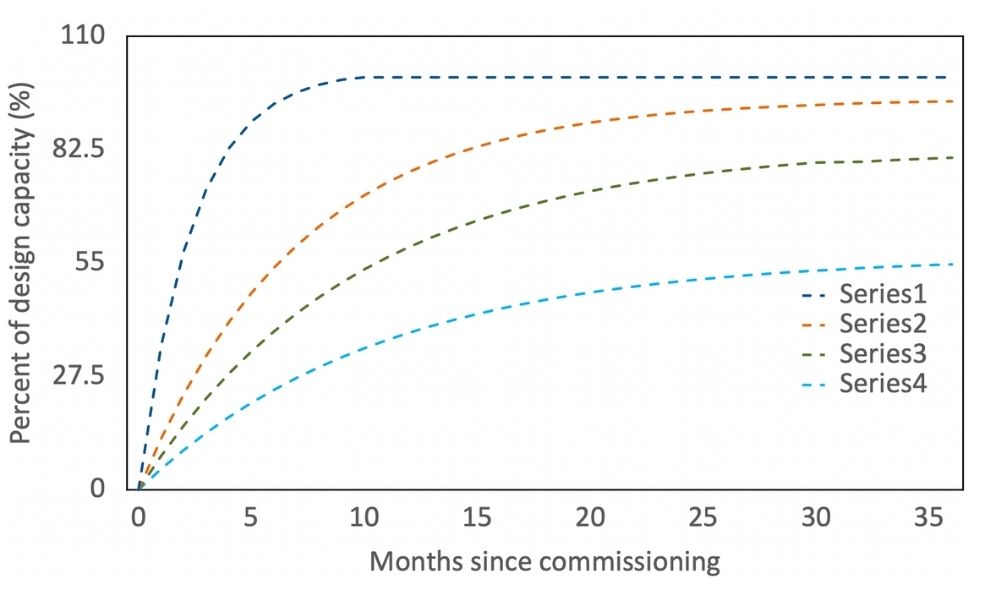
The empirical McNulty curves are widely used by industry to measure the success of commissioning and ramp-up of hydrometallurgical plants, and to estimate how long a plant will take to reach nameplate capacity before project funding is committed. McNulty considered two main criteria: the novelty and complexity of the process, and the capability of the project team implementing it. The Series 1 curve applies to proven processes delivered by highly capable teams, which reach 90% of capacity in six months and 100% within one year.
SART and Selen-IX™ are still considered novel by many in the industry. SART was invented by Chris Fleming at SGS Lakefield in 1998 to recover and recycle cyanide consumed by base metals, while recovering copper and zinc into high-grade concentrates. Before 2020, nine industrial SART plants had been built worldwide, none in Canada or the United States, and BQE Water provided design, commissioning or operations support at four of them. Selen-IX™ was invented by BQE Water and patented in Canada and the United States in 2013. It removes selenate to below 2 ppb without releasing new constituents into treated water and produces a stable residue suitable for re-use. No industrial Selen-IX™ plants existed before 2020.
The presentation reviews three SART plants commissioned between 2020 and 2025 (Zhongkuang, Zhaojin and Shandong Gold) and two Selen-IX™ plants (Kemess and Hermosa). These plants ramped up faster than the McNulty Series 1 curve, despite highly variable plant feed and EH&S risks specific to these processes. The Shandong Gold SART plant recorded no environmental, health or safety incidents during commissioning or operation in its first year.
The authors attribute these results largely to the project execution model. On these projects, the process expert was accountable for engineering, automation, equipment selection, commissioning and plant operation, not only process design. All professional services from initial lab testing to operation were sole sourced, and operations fees were at risk subject to plant performance. The authors concludes that the execution model, incentives and risk allocation within a project team may predict performance more reliably than the novelty of the process itself.
KEY FINDINGS
- Recently commissioned SART and Selen-IX™ plants ramped up faster than the McNulty Series 1 curve, despite highly variable plant feed
- The Shandong Gold SART plant recorded no EH&S incidents during commissioning or operation in its first year
- A single point of accountability, from lab testing through to operation, reduced interfaces and increased transparency
- Operations fees tied to plant performance aligned the interests of the service provider and the project owner
- The authors recommend expanding the McNulty analysis to include the role of process experts, the project execution model, competitive bids versus partnerships, risk allocation and incentives